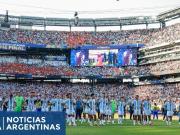
According to The Athletic, Gianni Infantino has refused to resign after his plans to sell FIFA's commercial interests were revealed, and he has received public support from some of FIFA's top officials.
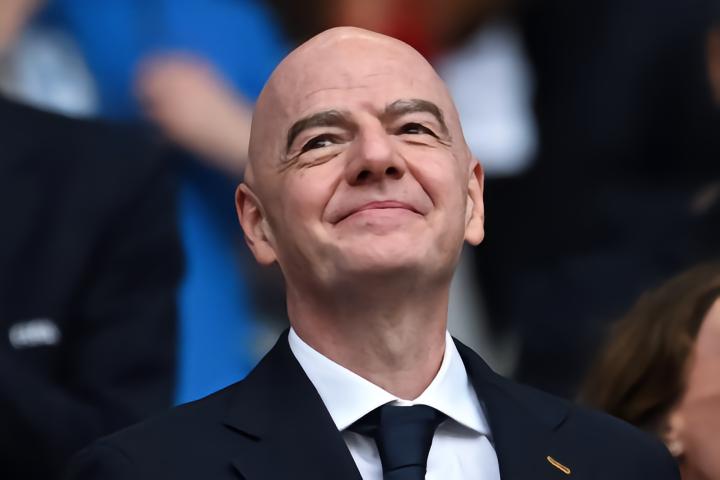
For those who thought Gianni Infantino would resign quickly due to public pressure, the answer is now clear.
Infantino persists. Late Wednesday, he appeared to have achieved his first victory since his secret plans to sell his FIFA commercial stake were revealed. Infantino has convened the FIFA management committee in Morocco, where he plans to open FIFA's African office by the end of 2024.
Morocco is one of the co-host countries of the 2030 Men's World Cup, and in recent days, it has been one of the few places in the world where Gianni Infantino feels at home. After Infantino was forced to abandon the plan last Friday evening, local time, the Royal Football Federation of Morocco was one of the first football associations to stand up for him.
FIFA's offices in Rabat are even located within the Mohammed VI Football Complex, which is also home to the Moroccan Football Federation, whose president, Fouzi Lekja, is also a member of the FIFA Council.
Not all members of the FIFA Management Committee were present. Global Football Development Director Arsène Wenger, Chief Football Officer Gil Ellis, and Chief Operating Officer Kevin Lamour were both absent. Lamour had accused Infantino last Friday of "cheating" staff with a "one-man project." Wenger issued a statement on Tuesday saying that abandoning the plan was "necessary," but he appeared unlikely to take further action.
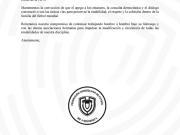
Instead of reprimanding Infantino, the members of the governing committee who arrived in Rabat signed an unusual pledge of confidence. The statement said that the attendees "reaffirmed their full support for the FIFA president."
It is worth noting that this includes FIFA Secretary General Matthias Grafström. Just on Tuesday local time, he also wrote to all FIFA staff, condemning "a series of sad and reprehensible events, thankfully the FIFA Forward Enterprise project has been permanently abandoned."
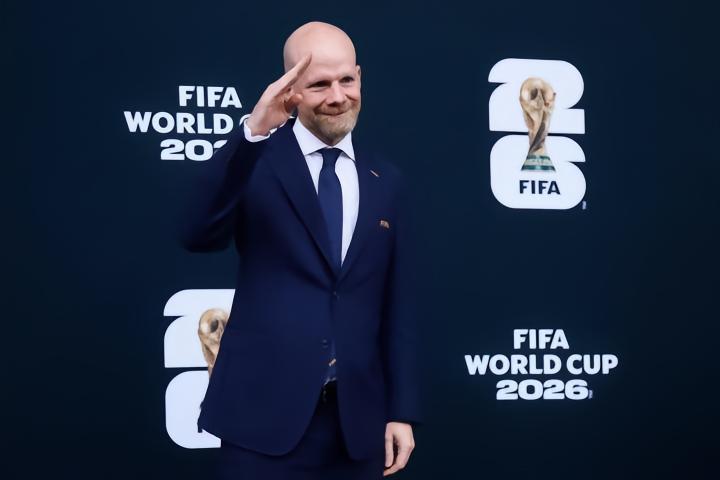
Multiple sources, speaking on condition of anonymity to protect their relationships, said that Grafström was not involved in developing these plans. A series of decisions by Infantino over the past year have damaged his relationship with Grafström, including Infantino's excessive overtures to US President Donald Trump and the expansion of the Club World Cup and the World Cup.
In a memo on Tuesday, local time, Grafström even wrote that individuals were "coming and going," which many interpreted as meaning he might be prepared to prioritize FIFA's interests over Infantino's future. European planners began to believe they might find a worthy ally within Infantino's power structure.
But on Wednesday local time, FIFA's second-in-command, Grafström, made significant concessions to Infantino, and they jointly signed a letter to all FIFA's 211 member associations.
The letter acknowledged that the “processes, communication, and interactions” between Infantino, Grafström, and the Management Committee could be improved, while also admitting to having made “mistakes.” Infantino and Grafström wrote, “We sincerely apologize for these mistakes and promise that they will not happen again.” They then stated that they would conduct the “necessary review” and submit the results at the next FIFA Council meeting.
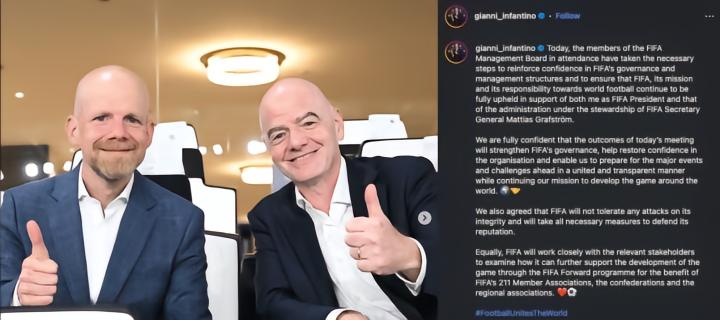
Given that Grafström did not devise these plans, it is unclear why he felt the need to apologize, aside from offering support to Infantino. The two even posed for a photo of themselves smiling and giving a thumbs-up and posted it on social media.
After expressing some remorse, the letter turned its attention to counterattacks, stating that FIFA would "no longer tolerate" attacks on its integrity, governance, and due process, and would take "all necessary measures to protect and uphold its name and reputation." The letter also claimed that everything related to the Infantino project was "fully compliant" with FIFA's regulatory framework.
Therefore, Infantino shifted from a defensive to an offensive stance, gaining the support of many, but not all, of FIFA's top staff. The immediate reaction, especially in Europe, was anger. Some tried to interpret Grafström: Was he helping Infantino maintain his position? Was he waiting for Infantino's opponents to gather enough votes to oust him? Was he exploiting Infantino's weakness to gain concessions, power, or influence? Was he vulnerable to potential revelations from Infantino about him?
This once again demonstrates that Infantino's enemies and potential replacements are now embroiled in a struggle that will only grow dirtier. Since Infantino withdrew his plans, these adversaries have launched multiple attacks on the FIFA president.
UEFA, the governing body of European football, stated that the FIFA leadership has lost its confidence. CONCACAF (Continental, Central American and Caribbean Association Football) called for a "full review" of Gianni Infantino's presidency. Both organizations encouraged their member associations to withdraw letters supporting Infantino's re-election. More than 200 such letters had been submitted before the World Cup ended.
Several European countries have publicly withdrawn their support, including England, Wales, Serbia, Greece, and Sweden. However, other countries, such as Switzerland, have not yet followed suit, stating they want to communicate one-on-one with Gianni Infantino before deciding on their next move. Associations under the CONCACAF have also not yet taken action, with several saying they are in no hurry to express their views because nominations for the presidential election next spring will not begin until November.
Others, however, have fewer concerns. Prince Ali bin Hussein, a former FIFA presidential candidate and a high-ranking official of the Jordanian Football Federation, accused FIFA of trying to "blackmail" the Jordanian Football Federation by demanding its support for Gianni Infantino's re-election as FIFA president.
On Tuesday local time, Prince Ali made a scathing statement on social media, claiming that FIFA failed to help Jordanian fans obtain visas to enter the United States during the World Cup, and also mentioned tax bills incurred by the Jordanian team for participating in the US, as well as unpaid fees from the FIFA Arab Cup last December.
Also this week, The Athletic reported on Saturday that FIFA has still not paid the $250 million solidarity payment to clubs for the 2025 Club World Cup. The 2029 Club World Cup is also in doubt due to the lack of participation agreements between clubs and FIFA, and clubs are angry about Gianni Infantino's attempt to sell his stake in the tournament.
Subsequently, The Athletic reported on Tuesday that several U.S. cities are pursuing millions of dollars in unpaid debts from FIFA. Meanwhile, Sky News reported that FIFA had sent "pre-written letters" to various football associations, providing templates for statements supporting Gianni Infantino's re-election as president, raising questions about Infantino's integrity.
On Wednesday, local time, documents were leaked to several media outlets, showing that FIFA was involved in developing early plans for the European Super League, though this was not proven. The proposal was halted in the spring of 2021, and Gianni Infantino subsequently publicly condemned it.

Last night local time, FIFA responded to The Guardian's report by citing a statement from Gianni Infantino, saying that FIFA "strongly opposes" the European Super League plan.
Infantino has also drawn criticism from former Barcelona and Real Madrid winger Luis Figo, who is currently a paid consultant for UEFA. To the average fan unfamiliar with his relationship with UEFA, this appears to be a sudden public attack. Figo called Infantino's plan to sell FIFA rights to private investors "the most deceptive, cowardly, and selfish thing I've ever seen." He promoted his article for the Daily Mail on social media, with the post receiving over 6 million views.
Figo stated, "Infantino has downplayed the position he promised to promote. He lied, cheated, and tried to benefit himself at the expense of the sport of football, which he should have served."
Infantino's support among politicians is also waning. After Britain's new Prime Minister Andy Burnham called for his resignation, Canadian Prime Minister Mark Carney stated that he had no "confidence" in Infantino.
Carney said, "This should be fatal. Of course, I have no confidence in Mr. Infantino."
Carney added, “I’ve managed several organizations. What I’ve called good governance is not disclosing a major issue to your closest advisors, COO, and board colleagues, even if you’re just considering it, let alone bringing it up. That should be fatal; you’ll lose the trust of that person.”
Cani also endorsed CONCACAF President Victor Montagliani. It is widely believed that Montagliani is the most likely rival to Infantino if he can secure enough votes. Like most international football executives, Montagliani has not given any media interviews in the past week, nor has he commented on the matter or explained how FIFA might function differently without Infantino.
Late last night local time, Infantino did not answer any questions about the scandal, instead returning to his preferred communication platform, social media. He shared two statements of support, one from the Philippine Football Federation and the other from the Mongolian Football Federation.
Within the Asian Football Confederation (AFC), Qatar, the UAE, Bhutan, Sri Lanka, Lebanon, and Kuwait have also joined in supporting Infantino. If real competition emerges, Asia will be a key battleground.
The Saudi Football Federation is electing a new president. Although Gianni Infantino pushed for Saudi Arabia to host the 2034 World Cup on its own, the federation has not yet commented, though this may just be a procedural delay.
For Europe, where animosity runs deep, the weakness of the FIFA governing council may be disheartening. They may have hoped others would follow in the footsteps of Ramour and Carlos Cordeiro, now Infantino's former advisor, and stake their own positions on this.
They knew that to force Infantino to step down, they had to maintain momentum and attention, or they had to dig deep enough to find something significant enough to force even those most loyal to Infantino within FIFA and its member associations to reassess the situation.
Currently, these people have embraced Infantino's "shameless era": behavior is no longer bound by conscience, and actions no longer have consequences.